linkedin-sales-solutions-YDVdprpgHv4-unsplash

7 benefits of outsourced sales for recruitment Agencies in 2023

As Recruitment partners and agencies are making their first cautious steps towards a comeback, founders try to evaluate the outcomes of the lockdown and the impact of the economic recession. So, the question is: how to minimize the losses? Outsourcing sales might be one of the answers.

Recruitment agencies face the constant challenge of attracting new clients and filling job positions efficiently. Outsourcing sales can provide a range of benefits for such organizations. From increased flexibility to cost savings, outsourcing sales can help recruitment agencies achieve their goals more effectively. In this article, we will discuss 7 key benefits of outsourcing sales for recruitment agencies and how they can contribute to overall success.

Outsourced Sales at a Glance

Outsourcing sales can be a smart business decision, offering numerous advantages such as reducing costs. However, it’s important to consider the potential drawbacks as well. There are two main models of outsourced sales: full-stack and mixed.

Full-stack Outsourced Sales Model

In this model, the provider takes care of the entire sales process, from lead generation to closure. It’s a great option for start-ups, particularly technology companies that don’t have the resources to hire an in-house team.

Mixed Outsourced Sales Model

With this model, a company delegates a specific part of the sales process to a provider. There are three types of mixed models: vertical, horizontal, and geo-related.

a. Vertical Outsourced Sales Model – In this approach, the sales funnel is divided into two parts, one managed internally and the other externally. Typically, the provider handles the lead generation stage and passes the qualified leads or appointments to the internal sales team.

b. Horizontal Outsourced Sales Model – In this strategy, both internal and external teams work simultaneously, either sharing one market or dividing markets as needed. This approach is ideal for growth, expansion, testing new products, and sales strategies.

c. Geo-related Outsourced Sales Model – This model is often used by multinational companies with an internal team at their headquarters working solely on the domestic market and local providers to minimize risks and reduce costs in other regions.

Benefits of sales outsourcing teams

1. Financial Advantages of Outsourced Sales Teams

When it comes to outsourcing, cutting costs is always a top priority for companies. Sales outsourcing teams offer several financial benefits that can help businesses save money.

a. Salaries – While reducing employee salaries is a common way to cut costs, outsourcing sales teams can save money on managerial expenses. These teams often operate from lower-wage locations, and their large sales teams allow for a more efficient and cost-effective hierarchical structure.

b. Rent and Office Costs – Outsourcing sales teams can also help reduce rent and hardware expenses by operating from locations with lower costs.

c. Hiring and Training Costs – The average onboarding period for outsourced sales companies is typically two weeks to one month, compared to the three months it takes for a sales development rep to ramp up. This can significantly reduce hiring and training costs.

d. Techstack – Outsourced sales providers use up-to-date software that can reduce costs by bulk purchasing subscriptions or sharing one account between multiple reps.

2. Expertise

Managed sales services offer a range of expertise that can benefit companies without incurring a high cost.

a. Product and Industry Knowledge – Sales outsourcing teams have experience working with various products, services, markets, and industries.

b. Client Database – These teams also have a database of previous clients that they can draw from.

c. Management Expertise – Outsourced sales providers bring expertise in management and can help companies operate more efficiently.

d. Sales Process – Many providers have developed and trained their reps in effective sales processes to optimize performance.

3. Time-saving

One of the main benefits of sales outsourcing is the reduced time required for hiring and training employees. Additionally, the quick replacement of employees in case of churn, vacation, or illness helps to maintain a consistent workflow.

4. Scalability and Flexibility

Scaling sales can be challenging, but outsourcing provides the ability to grow or shrink the sales team as needed quickly. This is particularly useful in times of uncertainty when being able to adjust rapidly is crucial. An example is a biotech company that hired an outsourced sales development team to penetrate a small market, which generated so many leads that the cooperation had to be temporarily stopped.

5. Expansion into New Markets

Expanding into new markets, whether for a new product, region or target audience, can be facilitated by an outsourced sales team that can quickly build a sales process from scratch. The low costs and ability to withdraw anytime provide opportunities for experimentation and testing new strategies.

6. Accountability

One potential concern with outsourced sales is the lack of control over the external team. However, reliable providers often provide weekly or monthly reports to ensure accountability.

7. Risk Reduction

Outsourcing sales teams can help reduce the risks associated with building and managing in-house sales teams, such as the risk of hiring the wrong person. Hiring a local provider when expanding into a new country can also mitigate risks by providing knowledge of the local legislation, economy, and business rules.

Summary

Outsourcing sales can bring a lot of benefits to recruitment agencies. It can reduce costs by cutting salaries, rent and office expenses, hiring and training, and tech-stack expenses. Sales outsourcing teams also bring expertise in areas such as experience with your type of product or service, market, industry, clients, and sales processes.

In addition to these financial benefits, sales outsourcing can save time by onboarding reps more quickly, allowing scalability and flexibility, and expanding to new markets. It can also provide accountability through weekly or monthly reports and reduce risks associated with building and managing sales teams.

If you’re interested in outsourcing sales, we’re here to help! Reach out to us to determine what model will work best for your recruitment agency. We offer a Pay-per-cure model where you only pay us when we earn for you.

austin-distel-wD1LRb9OeEo-unsplash

Recruitment Models: In-House vs. Embedded vs. RPO vs. Hybrid

Recruitment can make or break a business. A strong talent acquisition function will get you top talent when you need it and ensure sustainable success for your business.

Choosing a suitable recruitment model is crucial to the ongoing and long-term success of your business. In this article, we cover existing recruitment models and provide answers that will help you determine which one works better for your business.

What Is a Recruitment Model? 

The recruitment model is a set of methods and systems to obtain hire. There are three “pure” recruitment models, including In-house, RPO, and Embedded. However, many companies, especially when it comes to tech giants, opt-in for the hybrid recruitment model, which is the mix of the mentioned “pure” models. 

For instance, the hybrid model can include:

  • In-house and RPO recruiters
  • In-house and Embedded recruiters.
  • RPO and Embedded recruiters.
  • All three models at once. 

We will explore the main recruitment models from different angles: 

  • How they work
  • For which businesses are they suitable
  • What are the costs
  • What are the pros and cons of each model

After reading the article, you will get an idea of where to get started in choosing the right recruitment model to scale your team. 

Diving into Recruitment Models: The Main Types

In-house recruitment model

The first model is in-house recruitment. This entails building an internal team that is responsible for talent acquisition. This team can consist of permanent, fixed-term employees and/or contractors on the payroll. 

These recruiters work exclusively for your organization and focus on bringing the right people on board. The recruiters are part of your company, which means they can be better equipped to find the right fit for your unique company culture and hiring needs.

RPO model

In the RPO (Recruitment Process Outsourcing) model, you rely on an external organization to cover some or all hiring processes. For example, external recruiters may only work on sourcing and screening candidates. Or they can also take responsibility for workforce planning, negotiating job offers, and onboarding your new employees. 

These recruiters provided by the external entity may work solely with your organization or multiple clients, depending on the agreement.

Embedded recruitment model

Embedded recruitment means embedding a recruiter and a sourcer into a company to reinforce or act as the client’s talent acquisition team for an agreed-upon amount of time. 

Combining the expertise of an RPO and the rapport of an internal HR department, embedded recruiters cover the before and after of a recruitment strategy that makes it foolproof, from attracting the right talent with a well-positioned employer brand to engaging them throughout the candidate experience journey.

What to Consider When Choosing the Recruitment Model

Many things should be considered when deciding on a recruitment model, such as the scope of responsibility, cost-saving, scalability, expertise, and degree of control. Check out some of the key differences between the different models under each of these scopes. 

Scope of responsibilities

The great thing about having an in-house human resource team or embedded team is that you get their undivided attention. On the other hand, RPO agencies can juggle many hats beyond recruiting.

In-house: Your in-house team has the edge over knowing your company culture, industry fit, and specific hiring needs. They have multiple areas of responsibility, including workforce planning and development, employee and labor relations, risk management, employee engagement programs, and recruitment, among others.

RPO: External service providers can offer less flexibility when managing responsibilities. As some recruiters or sources could be managing multiple clients. However, they can guide effective workforce planning, employer branding, training and development, building long-term talent pools, and more because of their experience.

Embedded model: Like internal hiring, it also meets the needs of a single company. Thus allowing for support in multiple areas with the added experience that the RPO model provides.

Cost-savings

In-house: Hiring new staff members doesn’t come cheap. Companies would face financial challenges with fixed HR expenses and even intangible costs like time to hire a full-time team. These are all on top of the compensation, benefits, training, and other overhead costs.

RPO: Working with an RPO can cut your costs significantly as opposed to hiring in-house HR employees. Finally, you wouldn’t have to bother paying a monthly fee on LinkedIn and other recruitment platforms and tools.

Embedded: One of the most prominent advantages of opting for an Embedded Talent Team is their pricing. Unlike hiring internal recruiters, you don’t have to pay salary, benefits, and equity – saving you a significant amount of time, and potential risk, over the long term. The fixed-cost pricing also results in the consolidation of many of your recruitment costs. The cost of many tools, such as access to different job boards and talent pools, are included in the price – helping you consolidate all the expenses to hit your hiring goals.

Scalability

The RPO and Embedded model is designed to conveniently scale recruitment processes and resources up or down at a cost that won’t hurt your business.

In-house: Hiring or building your own company’s in-house recruiters could come in handy when business is booming. But what happens when you realize you need to scale down after a few months? This could only leave your company with a financial dent and a surplus of resources. Additionally, scaling your business up at short notice can be a challenge for an in-house recruitment team.

RPO: Hiring the expert services of an RPO can help expand the size of your team at a comfortable rate. Working with an external service provider allows you to focus on more important business while ramping up your team.

Embedded: Working with an embedded team allows scaling your business up at short notice while maintaining the right company culture that can be lost with RPOs.  

Degree of control

Control is crucial for businesses. Outsourcing will not mean relinquishing control over your recruitment process. You will, however, have more limited power over a third-party recruitment team compared to an in-house department.

In-house: You get more control over full-time employees because their sole focus is your business. You can quickly delegate tasks and easily set priorities and workplace practices they can follow.

RPO: Working with an RPO means you may be fighting for your time with other clients. When you outsource too many responsibilities outside, you might work with maintenance people who only keep the light on as long as they’re paid.

Embedded: Similar to In-house, you get full control over the team because their sole focus is your business. They also work extremely efficiently and require minimal supervision.

Expertise

In-house: Surely, you wouldn’t hire an in-house recruitment team that isn’t an expert in their field. However, some may lack expertise in certain areas, such as managing all elements of the recruitment process, which is vital to your business’s competitive edge.

RPO: A recruitment process outsourcing agency utilizes technologies that provide optimal audit trails, comprehensive management information, better analysis, forecasting, and reporting for strategic headhunting.

Embedded: Have broader knowledge and spend more time in the market to find the right talents for businesses. They can also leverage experience from different companies to improve and modify the process. An embedded recruiter is also supported by their parent company.

Client relationship

In-house: The recruiter will often report directly to a recruitment function. They’ll have regular updates and activity check-ins with a Talent Director/Manager or an HR/People Lead. Despite having the freedom of fighting for a candidate or recommending that specific hires are made, this ultimately is a choice made by the heads of the division or hiring managers who have been involved in the process.

RPO: Recruiters usually work with multiple clients at the same time; therefore, it’s much harder for them to engage in a more spontaneous communication with stakeholders at your company. They also don’t actively participate in your company’s life and don’t join your communication channels like Slack, which doesn’t give them the opportunity to get to know your team and the culture of your organization.

Embedded: There is a higher level of trust, so there is a bigger influence on certain decisions. This is part of the overall service offered as ‘specialists’ in the field. Embedded recruiters deal with only one client allowing them to nature a strong relationship and participate in all the company activities.

Employer branding

In-house: When internal, a recruiter handles marketing their company’s employer brand to attract candidates. They are an ‘ambassador’ for the company and have access to internal systems and a company email address. They will likely get access to other branding-related tools such as Glassdoor or LinkedIn Company Page.

RPO: Usually, reaching out on behalf of the client and using their company branding does reduce the quality of the candidate experience. Very often, they don’t even mention the company that they’re representing to avoid candidates from applying directly.

Embedded: Despite working in an embedded model, the responsibility of representing the client is the same as an internal employee. So this isn’t a difference, but something to make you aware of! There is an expectation that they become part of this company for the duration of your contract. In other words, to a candidate, it should appear as if the embedded recruiter is working directly for the client.

Pros and Cons of Different Recruitment Models

In-house

Pros:

  • Specialists know the culture and people well
  • Recruiters are experienced in internal processes
  • Specialists are always there when needed

Cons:

  • Slow to adapt
  • Costs can spiral/limit forecasting ability 
  • Not flexible
  • Can not be turned on and off

RPO

Pros:

  • Specialists/experts
  • Fixed cost (easy to estimate)
  • Has vast experience in different processes and methodologies
  • Can be turned on and off

Cons:

  • Settle in time
  • Needs buy-in from the hiring manager
  • Limited knowledge of company culture 

Embedded recruitment

Pros:

  • Knows the company culture 
  • Specialists/experts
  • Fixed cost
  • Has vast experience in different processes and methodologies
  • Can be turned on and off
  • Scalability is high
  • Always there when needed

Cons

  • It takes 2 weeks to settle in
  • Needs buy-in from a hiring manager.

Hybrid Recruitment Model: Eliminating Cons of the Standalone Models

Many companies, especially fast-growing ones, embrace several recruitment models at once. One of the scenarios is when a company already has hiring managers and recruiters, but they can’t deliver on their hiring plans. In this case, the company hires RPO agency or/and embedded recruiters. 

Another option is when the company doesn’t have a recruitment team. Cooperating with embedded recruiters allows one to close gaps in hires and build up hiring processes with the help of embedded recruiters. 

When it comes to cost optimization, the hybrid model may work as well. The company can compare the efficiency of different models and choose the best options for a particular growth stage. 

How to Make the Right Decision: Answer these 3 Questions

1. Does the process directly relate to your business’s core value proposition?

Focusing on your core business activities and outsourcing the rest has many benefits, including:

  • It helps you create a business culture where everyone is focused on achieving the same goals.
  • It reduces the amount you spend on business functions that don’t directly contribute to revenue growth.
  • It’s a cost-effective way to improve your team’s efficiency. 

2. Do you have the time to recruit, train and manage additional employees?

Hiring and managing in-house employees requires a significant time investment. Before you hire, consider whether your leadership team has the time to effectively manage additional employees and if it’s worth their time to do so.

Here are some signs that your business doesn’t have the capacity for additional employees outside of product/sales roles:

  • You don’t have a manager who has the knowledge and/or time to effectively guide employees on projects that are outside of your core business.
  • Your company already struggles to keep up with your existing HR needs.
  • It’s challenging for you to find affordable talent to serve in non-core areas of your business.

One of the biggest benefits of hiring a professional services firm is that they’ll take full responsibility for finding, training, and managing the people working on your account. 

3. What are the complete costs of hiring in-house vs. outsourcing?

When comparing the cost of outsourcing vs. hiring in-house, hourly wages are often deceptive because they’re only one piece of the total costs. You need to consider additional expenses, including:

  • Benefits
  • Perks such as bonuses
  • Taxes
  • Materials (computer, desk, software, etc.)
  • Management time
  • Training
  • Recruiting

Answering these three questions will help you answer which recruitment functions you should outsource and which you should keep in-house.

Still unsure about which recruitment model to prefer? Ask us, and we’ll dive into your particular situation and help you get a clear vision of how to better deliver on your hiring needs.

Greenhouse

ATS Review Series: GREENHOUSE

Greenhouse

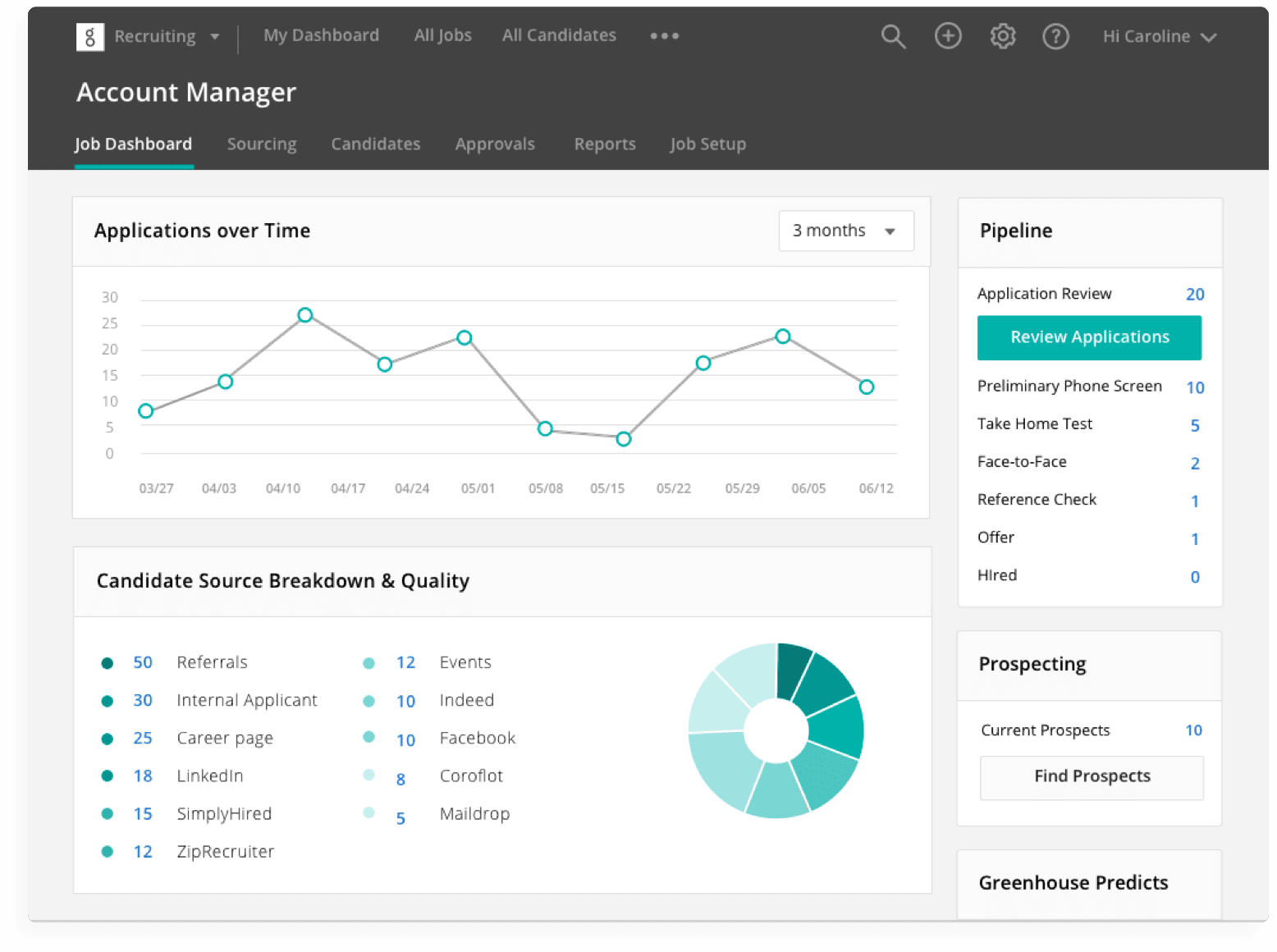
Greenhouse is a popular applicant tracking system (ATS) known for its comprehensive and flexible features. Here is an analysis of the system, including its pros, cons, cost, and user feedback:

Pros:

  • Comprehensive feature set: Greenhouse offers a wide range of features designed to make recruitment more efficient and effective. Some key features include customizable application forms, advanced resume parsing, automated workflows, and reporting and analytics tools.
  • User-friendly interface: Greenhouse is known for its user-friendly interface, which is easy to navigate and understand. This makes it easy for organizations to get started with the system and begin using its features right away.
  • Advanced automation: Greenhouse has a wide range of built-in automation tools that can help to streamline the recruitment process. These tools can save organisations a significant amount of time and effort compared to manually performing tasks.
  • Integrations with other tools: Greenhouse offers a range of integrations with other recruitment tools, such as video interview software and assessment tools. This allows organisations to streamline their recruitment process further by connecting with tools they already use.

Cons:

  • Higher cost compared to other ATS: Greenhouse is considered as a high-end ATS and the cost is relatively higher than some other ATS systems available on the market.
  • The steep learning curve for beginners: The system is quite robust and can be a bit challenging for organizations unfamiliar with using an ATS. Some users report that it takes some time to fully understand and utilize all the features offered by the system.

Cost:

  • The cost of Greenhouse is not publicly disclosed as it is usually negotiated with the company. However, as mentioned earlier, it’s a relatively higher-end ATS, and some reports suggest that it could be on the higher end of the pricing spectrum.

User feedback:

  • Overall, Greenhouse has received positive feedback from users. Many organizations appreciate the system’s comprehensive feature set, user-friendly interface, and advanced automation tools. Some users also report that it has helped them significantly reduce the time and effort required to manage the recruitment process. However, some users also mentioned the cost and the steep learning curve as potential downsides of Greenhouse.
arlington-research-kN_kViDchA0-unsplash

5 Top Recruitment Trends to Focus On in 2023

The impact of the COVID-19 pandemic, the Great Resignation, and the recent economic crisis have resulted in permanent changes to the work environment, and talent leaders need to adapt. To attract and retain top talent in 2023, it will be crucial to focus on digital-first strategies and use targeted communication tactics. In this article, we’ll highlight the leading trends affecting recruitment this year.

1. Employer Branding

The importance of employer branding in attracting job seekers is becoming increasingly vital as employees have higher expectations of the companies they work for. 57% of job seekers state that a company’s brand is a significant factor when considering a new job. To effectively reach potential candidates, it’s necessary to do more than rely on the marketing department’s brand guidelines.

To enhance your employer’s brand and reputation, it’s essential to consider the current trends necessary for employees, such as corporate sustainability, culture, diversity, equity, and inclusion. Surveys have shown that 70% of job seekers prefer to work for companies committed to diversity, and 41% of candidates will decline a job offer if the company’s sustainability values don’t align with their own.

To strengthen your brand and reputation, focus on implementing and investing in internal sustainability, culture, and DEI programs, including following ESG standards, promoting positive hybrid workplace models, and providing inclusive mentorship and training opportunities. Additionally, develop a content strategy that aligns with your audience’s needs and showcases your unique offerings.

2. Data-driven recruiting

With companies increasingly focused on gaining cost efficiencies, recruiters are going to be put in the position of needing to gain deeper data analysis skills to meet C-suite’s expectations. Since recruitment strategies can span across several channels, programs and departments, it’s more important than ever to have a data-backed strategy that tells you exactly where your efforts are most profitable and efficient to gather quality candidates.  

Suppose you’re not actively using Google Analytics (or a supplemental website analytics tool), an email automation tool, and an Applicant Tracking System (ATS). In that case, it’s time to familiarize yourself with their capabilities. The expertise to correctly set up such tools and reports can come from your internal marketing teams, your software’s customer support, or a trusted recruitment marketing partner. A complete outline of critical KPIs to discuss with your teams can be found in our previously stated Guide to Successful Talent Acquisition. While it can take several months to integrate a proper reporting system for your recruitment efforts, you’ll know that you’re well on your way to having a solid data structure in place when you’re able to answer the following questions intelligently: 

  • What are your hiring goals (i.e., number of hires, the top source of hires, acceptance rate)? Are you hitting your monthly KPIs? 
  • How long does it take to onboard and train a new employee? 
  • What is the quality of your candidates and hires? 
  • How much does it cost to recruit a new candidate? 

With proper reporting structures, Investis Digital enabled clients to achieve goals like a: 

  • 25% increase in applicants 
  • 74% reduction in cost-per-applicant 
  • 206% increase in conversions

3. Talent pool growth & usage 

Recruitment marketing requires building a qualified talent pool through various strategies, including content creation, online engagement, analytics tracking, and a CRM. The goal is to gain the audience’s trust and contact information. Segmenting email lists and communications is a best practice to personalize communication and avoid spamming. Investing in nurturing first-party lists of engaged individuals can lead to cost-effective communication in the long run. The talent recruitment industry is growing, and competition for attention is increasing, so it’s essential to gather your share of the talent pool now.

4. Freelance & fractional professionals

The increase in freelance professionals results from technological advancements, economic changes, and full-time employees opting for side hustles. It’s time to consider the benefits of incorporating freelance specialists and fractional executives into your company. Using internal data from operations and project management teams, identify which projects may not require full-time hires. While it’s not advisable to only hire freelance and fractional employees, a mix of full-time and part-time staff can make the company more efficient in 2023.

If part-time professionals are suitable for your company, ensure that job postings are updated and remain competitive with other similar posts. Building recognition with a new audience takes time. One way to start is by building relationships with freelance/fractional service organizations or agencies that provide outsourced work.

5. Retention

The impact of the Great Resignation is still felt as many are still changing jobs, as seen on LinkedIn. As employers, it’s essential to maintain high morale and attract new talent while competing with companies offering better remote/flexible work, unique training, and positive cultures. Only one in four employees are confident in their current careers, making employee retention a top priority in 2023.

Although budgets may be cut, HR departments play a crucial role in the company’s success. Invest in retention efforts that matter most, surveying staff and recent hires to understand what advances their careers and what they’d like to see. Based on career levels and departments, the survey will provide a comprehensive understanding of what matters most to your talent. Managers should act on findings and use positive company programs and accolades to enhance their EVP and employer brand.